Isotope – The atoms of an element having the same atomic number but different mass numbers are called Isotope.
For example – All the uranium atom contains 92 protons, so the atomic number of all the uranium is 92. Now, some uranium atoms contain 143 neurons so their mass number is 92 + 143 = 235 while other uraniums contain 146 neurons and their mass number is 92 + 146 = 238 so the two types of atom of uranium having the same atomic number of 92 but different mass number of 235 and 238 are called isotopes of uranium. Thus, uranium had two isotopes such as U-235 and U-238 in which 235 and 238 are the mass numbers and both have same atomic number is 92.
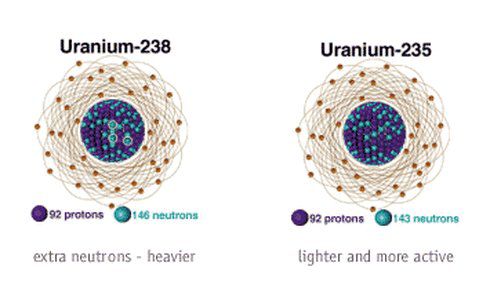
It should be noted that the isotopes of an element have the same atomic number because they contain the sane number of protons. Isotopes of an element have different mass numbers because they contain different number of neutrons. It is clear that the isotopes of an element differ in the number of neutrons in their nuclei.
Types of Isotopes – There are two types of isotopes such as radioactive isotopes and stable isotopes, which are discussed in detail
- Radioactive Isotope – These isotopes have an unstable combination of protons and neurons. This isotope decay usually emitting certain types of radiations, which include alpha, beta,and gamma rays. There are also some types of radioactive isotopes, which may depends on the formation process such as long-lived, cosmogenic, anthropogenic, and rafiogenic. Long-lived radioactive isotopes come out throughout the formation of the solar system. Cosmogenic radioactive isotopes occur as a reaction of the atmosphere to cosmic rays emitted by stars. Anthropogenic isotopes are simply man-made and made during nuclear activities including weapons testing and nuclear fuel while rafiogenic isotopes are the end result of radioactive decay.
- Stable Isotope – Stable isotopes have a stable combination of protons and neurons, so they have stable nuckei and do not display any sign of decay. This stability combination of protons and neurons due to the amount of neurons present in an atom. If an atom has too many or too little neurons, it tends to collapse and become unstable. Since stable isotopes do not decay, it does not cause any hazardous effects to human and other living things. They are useful during performing experiments in the environment and in the field of geochemistry. These isotopes may help to determine the chemical composition and age of minerals and other geologic objects. There are few examples of stable isotopes of potassium, carbon, vanadium, and calcium.

