Atmosphere – The earth is a solid and there is a mixture of gases surrounding the earth. The mixture of gases is called air. So the mixture of gases or the air envelope which surrounds the earth is called atmosphere. The atmosphere is held to the earth by the force of gravity.
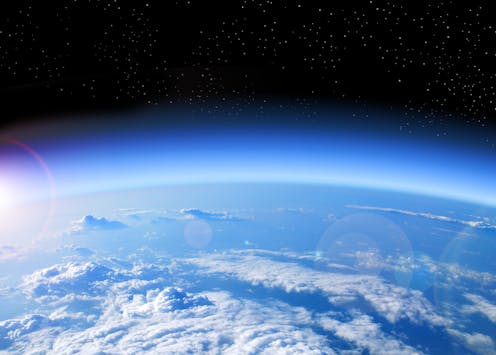
The major part of atmosphere extends up to a height of about 40 kilometers above the earth’s surface. There is around 99 percent mass of air is present in the first 40 km height. Above 40 km height from the Earth, the gases of air are present but in very smart amount. The atmosphere helps to protect living organisms from genetic damage by solar ultra violet radiation, cosmic rays, and solar wind. The density of atmosphere is reduces with height.
Composition of atmosphere – The atmosphere consists of a mixture of gases having a relatively uniform posotion in the lower layers. At the surface of Earth, the atmosphere consists mainly of two gases such as oxygen (21%) and nitrogen (78%). Thus, nitrogen is the most abundant gas in the Earth’s atmosphere whereas oxygen is the second most abundant gas in the atmosphere. The third most abundant gas in the atmosphere of Earth is a rare gas ‘argon’ , which is around 0.9% of the air. Apart ftom these major gases, the atmosphere also contain small amounts of other gases such as carbon dioxide, rare gases such as neon, hydrogen, helium, krypton, xenon, nitrous oxide, and methane. The lower layer of atmosphere also contains water vapour and fine dust particles wheras the uppwe layer of atmosphere contains ozone gas.
There are several layers in the Earth’s atmosphere are given below
- Troposhere – The depth of this layer varies between 17km at equator to 7km at the poles. Three quarter of the atmosphere resides in this region. The troposphere contsins around 75 percent of the atmospheric total mass.
- Ozone Layer – This layer situated mainly within the stratosphere and rich in ozone gas, which absorbs most of the ultraviolet radiations from the Sun.
- Stratosphere – This layer extends from top of troposphere to the bottom of mesosphere. It contains the ozone layer, which ranges in altitude from 15 to 35 kms. Ozone layer absorbs most of the ultra violet radiations from the Sun.
- Mesosphere – It ranges between 50 to 85 km and here most of the meteors burn up.
- Thermoshere – It is a very hot layer of atmosphere, which ranges from 85km to 600km where auroras (Northern and Southern Lights] occur and the International Space Station also orbits in this region.
- Ionosphere – In this layer of atmosphere, it contains heavily ionized and electically charged series of regions, which overlap the thermosphere and mesosphere, reflects radio waves.
- Exosphere – It is the outermost fringe of the atmosphere, which ranges from 600km to 10,000km
 daneelyunus
It’s nice to read the geography again
LikeLiked by 2 people
Thank you dear
LikeLiked by 2 people
Interesting topic
LikeLiked by 2 people
Thanks for appreciation and reading my post
LikeLiked by 2 people
We often take it for granted but we wouldn’t be here if it wasn’t for the atmosphere.. when you think about it for a long time it’s so wondrous and almost unreal isn’t it?
LikeLiked by 2 people
The study of universe and atmosphere is unlimited and full of mysteries which is very interesting
LikeLiked by 2 people