Rabindranath Tagore was known as Kobiguru Gurudev, or Biswokabi who reshaped Indian music, art, and literature in the 19th and 20th century. Rabindranath Tagore won a Nobel Prize in Literature in the year 1913, and became the first Asian, non-European, and lyricist to win a Nobel Prize in Literature. He won the Nobel Prize for his collection of poetry, which is named as Geetanjali (Song Offerings) in the year 1913. He was multi-talented as he was a philosopher, painter, writer, social reformer, composer, educator, and playwright. He wrote poems, plays, novels, songs, and short stories and also was a painter, social reformer, and an educator. Rabindranath Tagore was known by their several nicknames such as Kobiguru, Gurudev, and Biswokabi, and also wrote and composed the national anthems of India (Jana Gana Mana) and Bangladesh (Amar Sonar Bangla). He also established the school Santiniketan in the year 1901 and Visva-Bharati University in the year 1921 in the city of Kolkata, West Bengal.
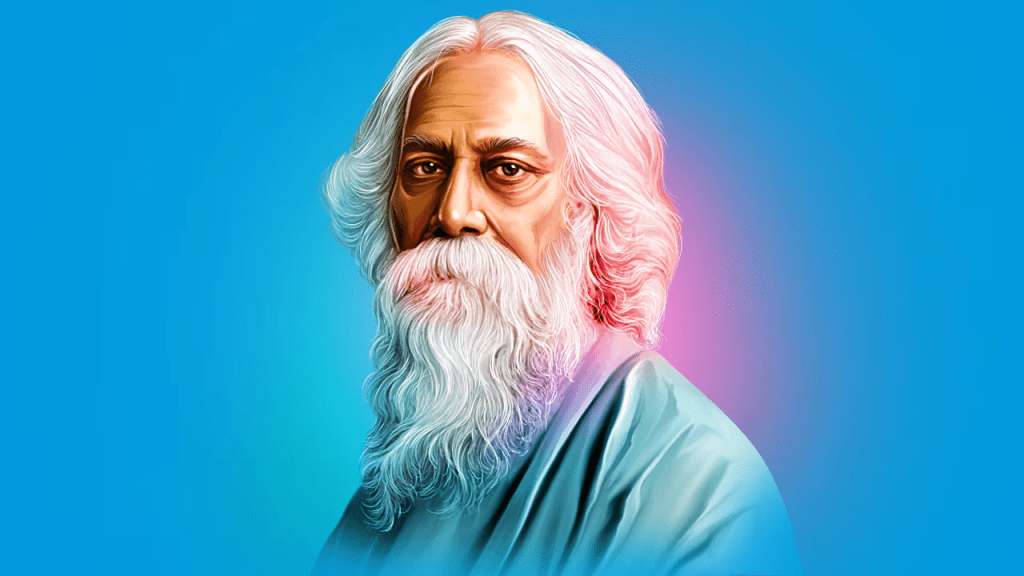
Rabindranath Tagore was born on May 7 in the year 1861 in the city of Calcutta (Presently Kolkata), West Bengal and, was a Bengali Brahmin who grew up in a distinguished and intellectually vibrant family. Debendranath Tagore (1817–1905), the father of Rabindranath Tagore, who was an important figure of the Brahmo Samaj, and Sarada Devi (1830–1875), the mother of Rabindranath Tagore, who encouraged a culturally rich environment at home. Rabindranath Tagore was raised mainly by servants because his mother (Sarada Devi) had died in his early childhood, and his father travelled widely
He was surrounded by music, literature, and philosophical discussions. Rabindranath Tagore wrote poem at 8 years old, was a Bengali Brahmin, and belongs to Calcutta (Presently Kolkata) with family gentry roots in Jessore (Bangladesh and Bardhaman districts (India). He introduced his first important poems under the penname Bhānusiṃha (“Sun Lion”) at the age of only 16 that were seized upon by literary establishments as long-lost masterpieces. The best or known work of Rabindranath Tagore are Gora (Fair-Faced), Gitanjali (Song Offerings), and Ghare-Baire (The Home and the World).
Rabindranath composed Jana Gana Mana in the year 1911 and sung firstly openly or publicly at the Calcutta Session or Meeting of the Indian National Congress on December 27, in the year 1911 and later was accepted as the national anthem of India in the year 1950. The national anthem or song expresses or talk the idea of a unified or united India, where various or different regions and cultures come together under a shared civilizational identity and give a message of unity, patriotism, dignity, and national integration in our country. He also wrote Amar Shonar Bangla in the year 1905 to oppose the Partition of Bengal and later was adopted as the national anthem of Bangladesh in the year 1971. Jana Gana Mana, national anthem of India signifies broader national unity whereas Amar Shonar Bangla, national anthem of Bangladesh represents deep emotional attachment to the nature, land and cultural roots of Bengal.
The great achievement of Rabindranath Tagore is to earn or receive the Nobel Prize in Literature for Gitanjali in the year 1913, and became the first Asian, non-European, and lyricist to win a Nobel Prize in Literature in 1913. He died at the age of 80 due to prolonged illness on August 7, in the year 1941 in the city of Kolkata, West Bengal. Earlier, he suffered from chronic or long-lasting health issues, such as uremia, kidney infection, and an enlarged prostate while he underwent a surgical procedure to ease or improve complications, he died due to his deteriorating condition.

