Now, India became the first country to land on the south pole of the lunar’s surface after the successful landing of Indian Space Research Organization’s Chandrayaan-3 on August 23, 2023, at 6:04 pm on the south pole of the moon. India is also became the fourth country for soft landing on the surface of the moon after Russia, the United States, and China. It’s a big achievement for the Indian Research Space Organization (ISRO) for the soft landing of Chandrayaan-3 on the south pole of the moon.
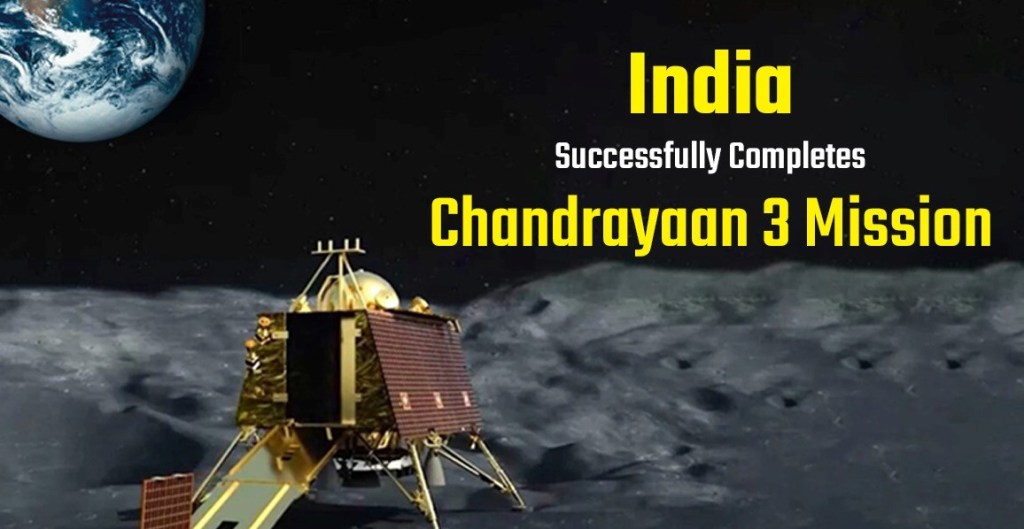
It’s also a historic or proud moment for Indians that India successfully landed Chandrayaan-3 on the surface of the moon. Indian Space Research Organization (ISRO) scripted history by soft-landing of Chandrayaan-3 on the south pole of the moon.
Chandrayaan-3 – It is the third moon or lumar mission of India which was conducted by the Indian Space Research Organization (ISRO). Chandrayaan-3 contains the Vikram lander and the Pragyan rover and is similar to the previous Chandrayaan-2 spacecraft however it does not have an orbiter. The distance between Earth and Moon is about 384,000 km and the spacecraft has been effectively located in the trajectory so it will take to reach the surface of the moon. Chandrayaan-3 contains a rover called as Pragyan and a lander known as Vikram. The main work of a rover is to carry out several scientific experiments on the surface of the moon and the main work of a lander is to soft landing on the lunar’s surface. The propulsion module in the Chandrayaan-3 is to carry the lander and rover configurations until the spacecraft is in a 100 km lunar orbit. Previously Chandrayaan-3 entered the lunar orbit on August 5, 2023. Previously, the Indian Space Research Organization (ISRO) successfully launched Chandrayaan-3 on July 14, 2023, at 2:35 pm from the Satish Dhawan Space Centre in Sriharikota in the state of Andhra Pradesh.
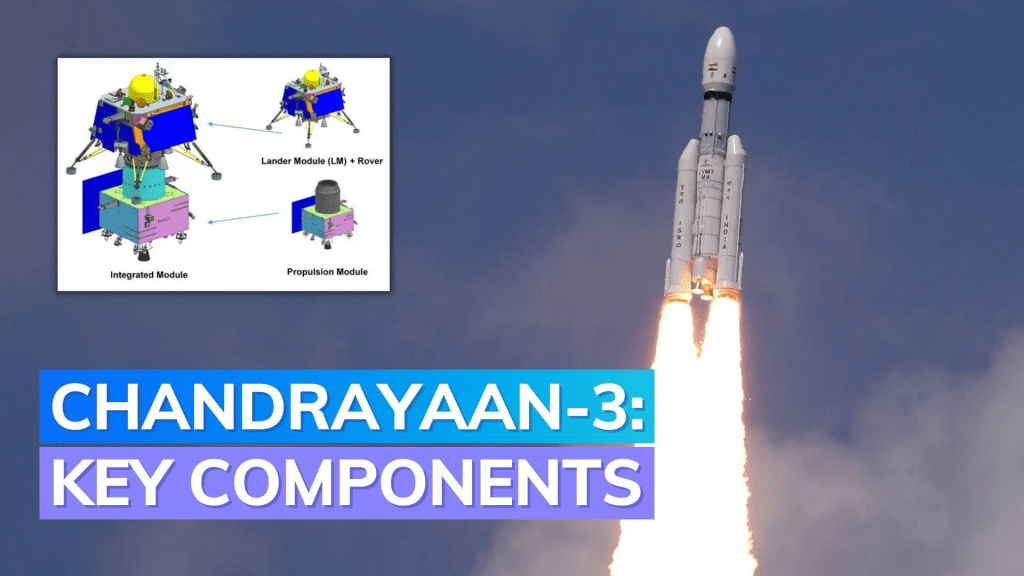
Main components of Chandrayaan-3 spacecraft – There are three main components of Chandrayaan-3 spacecraft are discussed below –
- Vikram Lander – The main work of a Vikram lander in the Chandrayaan-3 spacecraft is to soft landing on the surface of the moon. The Vikram Lander is box-shaped with landing legs and landing thrusters of 800 newtons each and will be responsible for carrying the rover and several scientific instruments to perform in-site examination or analysis. It also has four throttle-able engines with thrust valve slew rate-changing abilities. The Vikram lander is also equipped with an LDV (Laser Doppler Velocimeter). Is used to measure attitude in 3 directions.
- Propulsion module – The main work of the propulsion module is to carry the Vikram lander and Pragyan rover configurations to a 100 km lunar orbit. The propulsion module is a box-like structure that contains one large solar panel which is mounted on one side and a big cylinder on top which acts as a mounting structure for the lander.
- Pragyan Rover – It is also known as a planetary rover, is a terrestrial or planetary surface examination device that is designed for moving across the solid surface of a planet and several other planetary mass heavenly bodies. The main work of Pragyan Rover is to carry out several scientific experiments on the surface of the moon.
Objectives of Chandrayaan-3 Pragyan rover – The main objectives of Chandrayaan-3 Pragyan rover are given below –
- The presence of water in the moon soil.
- History of Moon impacts
- The composition of the Moon’s surface
- The evolution of the lunar’s atmosphere.
 daneelyunus